Showing posts with label bird-watching. Show all posts

Wednesday, May 09, 2012

Identifying Birds - An Experiment

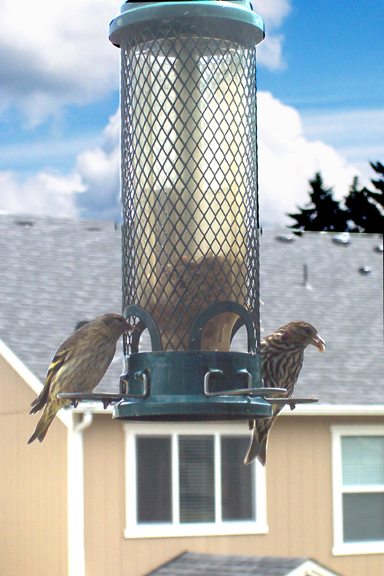
I've had a couple of bird families begin showing up at my bird feeder that I can't identify. I'm from Texas where everything at the feeder is pretty much a house sparrow or a chicadee, a squirrell or a blue jay. Here in Washington, we've got a new set of feeder birds.  The first I was able to identify was a dark-eyed Oregon junco. It took me verifying it with the Seattle Audubon Society website, but I was able to get a positive ID.  With these guys, not so much,

I think they are a pair, male on the left and female on the right. The female is striped all over. The male is striped on the belly with yellow bars on his wing.  You can see this more clearly on the pictures below. 

So here's what I'm going to do.  I'm going to ask friends on Facebook if they can identify the birds.  I'm also going to send a link to this page to a volunteer Master Birder at the Seattle Audubon Society and see if they can identify it.  It's the yellow markings on the male that are throwing me. The female looks like a common song sparrow. I haven't got a sample of their song yet, but if I do, I'll post it too.  I'll let you know how my search for the identity of these two is coming along. In the meantime, my poor little junco is outnumbered and having to slip in to the feeder while the new guys are off at the nest.


You can see the markings on the male's head and the striping on the belly and shoulders of the female.

You can see the yellow bars on the male's wings in this photo.


Tuesday, March 20, 2012

Making a Ghillie Hat

There IS a guy in a Ghillie suit in this picture.
If you have a hide for your body, a hood's all you need.

If you’re thinking of taking up wildlife photography, hunting, paintball or bird-watching, you’re going to need an easy method of camouflage. Oh, sure you can buy camouflage clothes down at Wal-Mart or a sporting goods place. Some even carry special patterns designed to match the local flora.  A little camo face paint and you’ll be hard to see for sure. For total concealment, however, nothing beats a Ghillie suit.

The Ghillie suit, developed by military snipers as a portable form of concealment, helps you blend indistinguishably into the terrain.  Ghillie suits are basically net covered outfits with strips of rope and rag tied to the nets. You’re basically dressing up like a big bush.

Ghillie suits aren’t the most pleasant of outfits to wear. They’re heavy, bulky and complicated to put on.  If you’re looking for a little extra to dress up your hiding place, a Ghillie hat might be the best thing for you.  Here’s how to make one.

Preparation:

Get a large floppy canvas hat and a circle of nylon or poly blend netting about six feet across and a natural Earth tone color.  Get a large needle and some clear or green monofilament fishing line. You’ll also need a little clear glue or hot glue. You’ll need strips of twine, jute and earth colored cloth so that you have a mixture of textures and thicknesses. Strips of an old camouflaged shirt work great for the cloth strips.

Assembling the Parts

  1. Cut the nylon netting so that it covers the hat and hangs down one to three feet over the edge of the hat brim as far as you wish.
  2. Lay the netting over the crown of the hat so the edges stick out. Add a touch of glue wherever the net touches the edge of the brim or the crown of the hat.
  3. Once the glue sets, stitch the net at all the glue points. To secure the net to the hat.
  4. Start at the outside edges of the net along what will be the bottom of the net.  Tie the strips of cloth, rope and twine along the first row of netting along the outside.
  5. Keep tying around the base, working your way up row by row. Alternate the cloth strips with twine and small bits of rope. The added upper layers will lay on top of the lower layers like a hay pile or brush heap.
  6. Use simple knots so you can untie them if you need to change the texture or colors in order to adapt your hat to different types of terrain.
  7. Work your way to the top of the net, adding layers to give the hat/hood a shaggy appearance.
  8. Spread out the ties that will be in front of your face to make it easier for you to see through the hood. You want enough strips to keep your face concealed without blocking your vision.  Remember you will be walking around in this rig on rough terrain. You need to see well enough that you won’t fall off a cliff or something.
  9. When you’re done, set the hat on a stick with the rags and ropes hanging down. Spray the outside of the hood camouflage colored spray paint. Use long erratic strokes, not heavy, but just thick enough to shade the strips.
  10. Let the paint dry, then season the hood.  Do this by leaving it outdoors for several days. A rainstorm would help remove the shine and smell. Drag it around in the grass and dirt, toss it in a lake, then hang it out to dry.  You have to remove the new smells and man odor.  The whole rig should smell musty like the woods.
Shorter strands give you a wig like effect for a lighter hood.

To wear the hat, just slip the net over your head and settle the hat on your head.  When you find a hiding place, squat down so your feet are concealed. Stop moving. Moving will give you away.

The hood will help the part of you that’s sticking up and looking around (your head) remain invisible to passing animals, birds and people. The net also allows you to stick branches and leafy fronds into the netting to increase the bush effect and conceal your big old punkin’ head under there.  Keep an eye out when walking to your hide for sticks and leaves and stuff that will improve your disguise and stick them into the netting.

When you’re going out, stick a roll of twine in your pocket so you can tie on things you find. Use a simple overhand knot so it’s easy to remove anything you tie on.

A Ghillie hat is a lot of fun and very useful for observing nature unobtrusively.

Tom


Saturday, January 14, 2012

The Rat Resistant Bird Feeder


(c) 2011 by Tom King

Our squirrel resistant feeder is 2 stories up.
Seattle has a century and a half long history as a major U.S. seaport and the rats to prove it. When you move to King County and go to hang your bird feeder, someone will inevitably warn you not to because it will “attract rats”. Sheila and I decided we wanted to see the lovely songbirds of the Pacific Northwest outside our window, so we decided to do a little research.

There’s a reason for the warning. Waste birdseed and feeders DO attract rats. Not only that, but pigeons, seagulls and crows can overpower your bird feeder chasing away the pretty songbirds and covering your back yard with bird poop and feathers. There are an awful lot of crows in Washington for some reason. Pigeons too.  People call them “rats with wings”.  Near the coast, the seagulls are also problematic. But you don’t have to give up your pretty birds, especially if you take care to keep your feeder clean and plan your feeding program carefully.  Here are some alternatives:

  1. Suet feeders are an easy alternative.  They generate far less mess than regular type seed feeders because suet comes in solid blocks of fat embedded with seeds, dried fruit and bits of protein. The block is placed in a wire cage and the birds peck at it, extracting the yummy bits.  Buy the low waste types of suet that have low percentages of millet as part of the mix.  Suet feeders attract both small and large birds.
  2. Buy low waste birdseed with a low percentage of millet and a lot of large seed types like cracked sunflower.  The oil-rich seeds will attract larger birds like jays, cardinals, and woodpeckers. Avoid seeds with a lot of filler like millet, milo and sorghum that the birds will cast aside to get at the tastier seed.
  3. Buy a squirrel proof feeder.  The weight of a mid-sized rat will close the squirrel feeder guards, making it difficult for them to raid the feeder.  Hang the feeder more than four feet above the ground.  Buy a long metal hanger that suspends the feeder well away (8 feet if you can manage it) from nearby structures.  Rats can climb a wooden wall or tree quite easily.  So don’t depend on vertical walls to slow them down.  There are some lovely “spinner” type feeders. These work by tripping a switch which starts a motor that will twirl the feeder and spin the rodents, whether squirrel or rat off the feeder. This is almost as entertaining to watch as birds feeding.
  4. Buy a Niger thistle feeder.  The screens are difficult for mice and rats to penetrate and the thistle seeds attract finches, juncos, towhees, buntings and the like. 
  5. Roll pine cones in peanut butter and birdseed and stick a few bits of fruit between the seeds of the pine cones.  Hang them on long lines from hangers where it will be difficult for rodents to get to.  Garlands of popcorn can be hung from the feeder. 
  6. Hang the bird feeler with a roller wire.  This kind of feeder hanger setup is easy to fix up.  Simply string a wire between two trees or the house and a post. Hang the feeder in the center and cut two pieces of 1-inch PVC pipe at least two feet long. String the wires through the pipes and hook the ends. When the squirrel or rat tries to climb out on the wire to get to the bird feeder, the pipe will roll under them and drop them to the ground. The tighter you can stretch the wire, the more loosely the pipe will roll.
  7. Maintain your feeder.  Don’t overfill it.  Try not to put more than the birds will eat in a day or so.  Rats need time to find food and work primarily at night.  Clean up any spillage off the ground.

Store your bulk birdseed in a sealed metal container. Rats chew through plastic in short order. Keep the area around the seed container cleaned up so the rats won’t be drawn to that area.

References: 

King County Health Services:  Bird feeders and Rats (Pamphlet)

Bird Feeders: FAQs - Wild Birds

Nature’s Corner:  Of Mice and Feeders

Wednesday, February 24, 2010

The Ultimate Birdwatcher Suit

Like to really have some fun bird-watching?  Then have I got a project for you.


  It’s the ghillie suit!

A ghillie suit (also called a yowie suit) is typically used by soldier or hunters as a highly adaptable type of camouflage.  The ghillie suit can be altered to make you look like virtually any terrain imaginable and help you completely disappear into the foliage. The ghillie suit is particularly well-suited to heavy foliage.

You can make one out of a darker earth colored jump suit or even, better – a camouflaged hunters pants, shirt and floppy fishing or jungle hat.  Here’s how you create your ghillie suit.  This will take some time to make the basic outfit, but once you have it, you can easily add to it when you are in-country to better blend into the local vegetation.

Start by laying out the clothing you are going to use.  Next you’ll need to get some netting.  An old volleyball net works nicely. You don’t want the holes in the net to be too small so that it’s hard to tie stuff to it.

Cut the net out to the shape of and a bit larger than the front and back of the shirt and pants.  For the hat, lay your hat on the ground and cut a circle of netting with a 3 to four foot diameter.

Do one side of the pants and shirt at a time.  Use shoe glue or other type of thick fabric adhesive and apply to the knots in the net at 4 to 6 inch intervals to glue the net to the clothing.  Allow to dry and then take some clear or dark monofilament line and a carpet needle and stitch the net to the suit at each glue point.  Do the front and back of the outfit.  Be sure to cut openings for the zipper and front of the shirt so you can take it on and off.

Next do the same to the hat and leave net dangling around the brim.  When done you’ll have an outfit with a lot of loose netting hanging from it.

Next cut out some rags that are in several dull earth colors.  Make 2 inch wide strips about 12 to 18 inches long.  Start at the bottom and tie a layer at a time to the netting all way round.  The next layer should hang down and overlap the layer above it.  Mix the colors up so you don’t have any large identical color patches.  Intersperse the rags with strings, thick twine and frizzy cord like jute.  You want to tie them on pretty thickly.  For the base layer, use good surgeon or square knots to make sure the pieces stay attached.  These will be more or less a permanent part of the outfit.  Tie rags and strings to the outside of the hood and work your way toward the center.  Tie more camouflage toward the back than the front to prevent the camouflage from impeding your movement.  Tie only a few light bits in front of the hood to prevent impairment of vision.

Next take 2 or three colors of earth drab spray paint and streak the outside of the camouflage rags and twine.  Don’t spray so heavily you soak the fabric.  Make light striations like streaks of sunlight playing over brush.

Next you need to remove the man-made smells of glue and fabric. You should leave the suit out in the grass for a few nights; maybe drag it through the woods or toss it in the lake and let it dry on the clothesline.  Be careful not to damage the suit, but give it enough seasoning to hide the human smells.

To adapt the suit to local terrain, grab your binoculars, ghillie suit and hood (don’t put it on yet) bird book, several dozen foot long pieces of dark string or twine and a pencil and strike out for your hidey hole.  You might want a backpack for all this stuff.

As you go, keep an eye out for bits of natural materials you can tie to the netting to make you look like the local terrain.  If you hide in a patch of flowers, you might want to make yourself into a loose bouquet. In the grass, tie stalks of grass all over your outfit. One soldier told me he once hid in a town dump by tying bits of garbage to himself so that he looked like a trash pile.  When you get to your hiding place, tie on all the stuff you found, slip on the suit and melt back into the foliage.

The suit uses three dimensional features like branches, leaves and grass to break up your outline. The ghillie suit fools the eye into not seeing patterns. Keep it loose and it will even move in the wind like the nearby bushes.  Be sure to tie things securely so your suit doesn’t make too much noise if you need to move a little.

Properly done, you’ll frighten the wits out of passersby when you, dressed as a trail-side bush suddenly stand up and say, “Lovely weather we’re having.”  You’ll frighten the wits out of birds too.  Properly done, though, they’ll never know you are there. Who knows they may try to build a nest on your shoulder.

Warning!

  • Be sure and shake out any bits of flotsam and jetsam you plan to add to your suit.  Make sure you don’t add any unwelcome critters.  Nothing spoils the illusion more than having a scorpion crawl up your trousers and send you leaping skywards.
  • Watch out when adding vines.  You don’t want to wrap yourself in poison ivy, poison sumac or poison oak.  This will make for an uncomfortable afternoon of birding!

* Photograph:  (c) 2009 by Chamal N. under the terms of the GNU Free Documentation License, Version 1.2 or any later version published by the Free Software Foundation; with no Invariant Sections, no Front-Cover Texts, and no Back-Cover Texts. A copy of the license is included in the section entitled "GNU Free Documentation License".